
Insights
China to Iran via Jebel Ali: how cross stuffing gets your cargo to Bandar Abbas, Bushehr and Bandar Imam Khomeini
Chinese ports, the UAE’s east coast, a container change at Jebel Ali and the final voyage to Iran: the route, the ports and the paperwork, explained for Iranian importers.
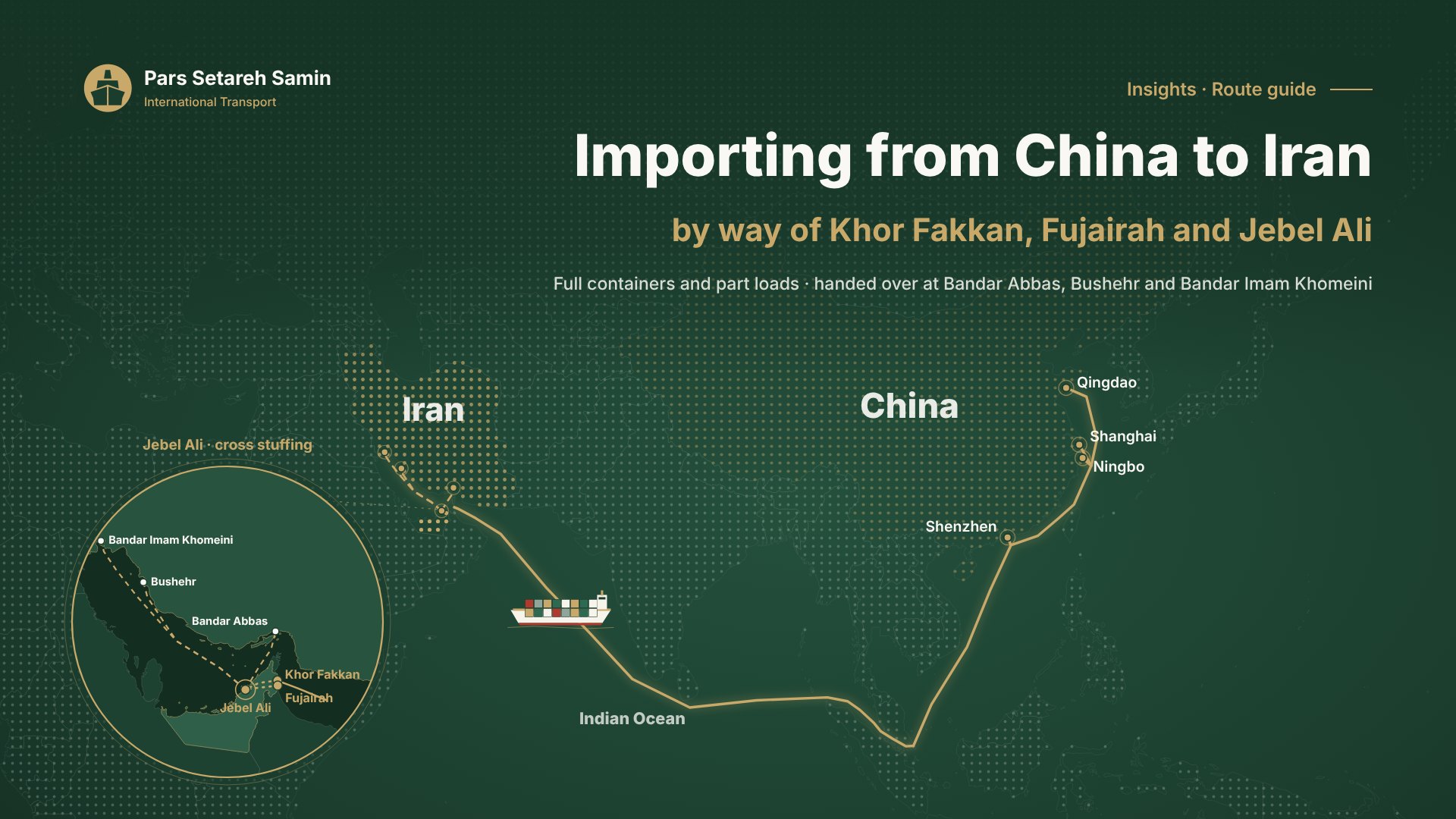
For an Iranian importer buying from China, the Jebel Ali route is now one of the most dependable ways to bring cargo home. Containers sail from Chinese ports to the eastern coast of the Emirates, to Khor Fakkan or Fujairah. From there our UAE operation takes over. The box travels under customs seal to Jebel Ali, the cargo is cross stuffed into a fresh container, and it sails on to Bandar Abbas, Bushehr or Bandar Imam Khomeini.
Full containers and part loads both travel this way. Below we follow a shipment from the supplier’s gate in China to the quay in Iran. We look at who is responsible at each point, which Chinese and Iranian ports fit which cargo, what really happens during cross stuffing at Jebel Ali, and which papers must be in order before anything is loaded.
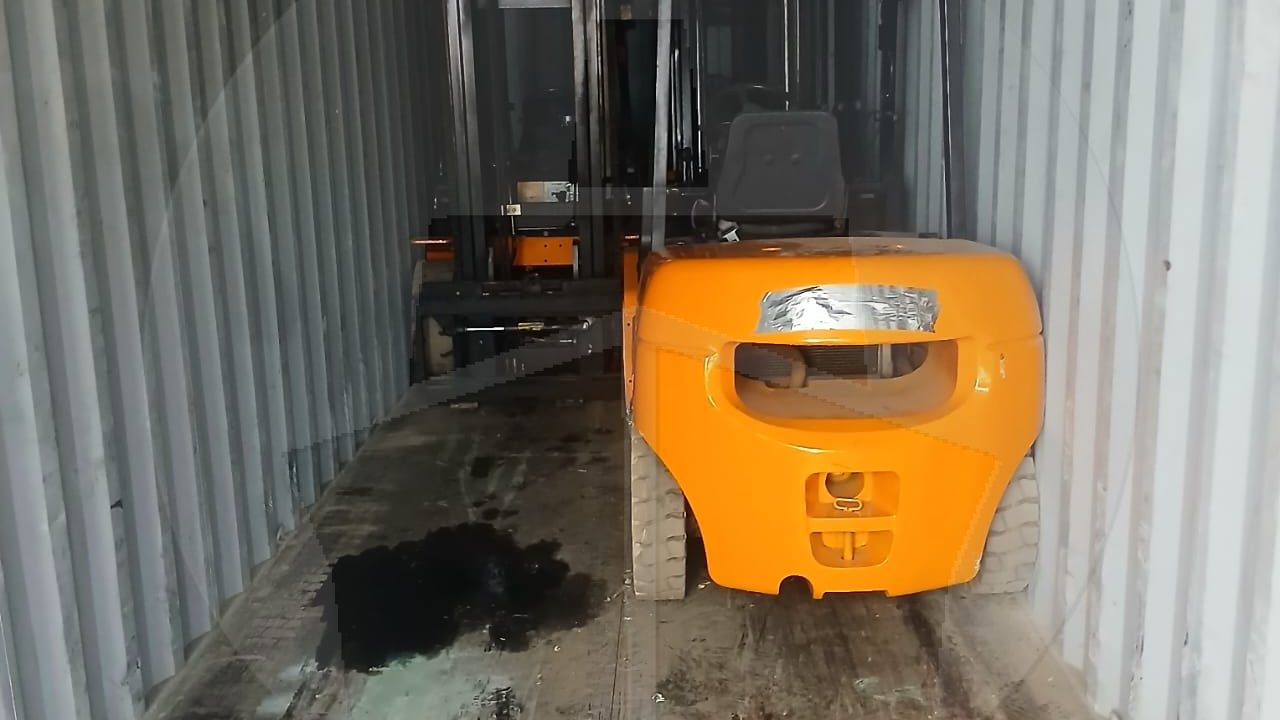
China to Iran through Jebel Ali, stage by stage
Whether you are shipping a full box or a few pallets, the journey runs through the same six stages:
- Cargo ready at the supplier. We agree the ready date, the delivery terms and the packing with you and the seller, then reserve space on a vessel discharging in the Emirates.
- Loading or grouping in China. A full container is loaded at the factory or a yard nearby. Part loads, and goods bought from several sellers, go to a grouping warehouse close to the port.
- The voyage to the UAE’s east coast. The container leaves Shanghai, Ningbo, Shenzhen, Qingdao or another Chinese port for Khor Fakkan or Fujairah.
- By road to Jebel Ali. Once discharged, the box is trucked to Jebel Ali under seal, supervised by UAE customs throughout.
- Cross stuffing. At Jebel Ali the cargo comes out, every package is counted and photographed, and it goes into a new container. The original box returns to the line that owns it.
- The last voyage, to Iran. The new container sails from Jebel Ali to Bandar Abbas, Bushehr or Bandar Imam Khomeini and is handed over at the port.
Why go through the Emirates?
Few container ports anywhere are as well connected as Jebel Ali, and its sea link with Iran’s southern ports is decades old. Sending Chinese cargo this way gives an importer some real practical advantages:
- Steadier connections. The China–UAE and Jebel Ali–Iran legs each run on their own sailings, so no single vessel holds your shipment hostage.
- Freedom over the Iranian port. The choice between Bandar Abbas, Bushehr and Bandar Imam Khomeini is made at Jebel Ali, to suit the consignee, even if everything arrived in one container.
- Eyes on the cargo halfway. Cross stuffing means the packages are counted and their condition is recorded before they ever reach Iran.
- A single team. China, the Emirates and the Iranian port are handled by one group of people, rather than a string of agents who never talk to each other.
Loading ports in China
Where the goods are made usually settles which port they leave from. Most Iran-bound cargo starts at one of these:
| Loading port | Where it draws cargo from | What it often carries for Iran |
|---|---|---|
| Shanghai | The Yangtze delta: Shanghai, Jiangsu, Anhui | Industrial machinery, electronics, chemicals, car parts |
| Ningbo | Zhejiang province, Yiwu included | Household goods, tools and fittings, consumer products, fabrics |
| Shenzhen | Guangdong and the Pearl River delta | Electronics, lighting, furniture, batteries, telecoms gear |
| Qingdao | Shandong and the north | Tyres, steel, machinery, building products |
| Further options | Tianjin, Xiamen, Guangzhou | Used when the seller is closer to them or the sailing suits better |
Sellers further inland, in Chongqing, Wuhan or Chengdu, send goods to the coast by river barge, train or truck. That first stretch has a delivery deadline of its own, well ahead of the ship’s, so we schedule it at the same time as the sea booking.
Khor Fakkan and Fujairah: the way into the UAE
Khor Fakkan belongs to the emirate of Sharjah. Fujairah is an emirate in its own right. Both lie on the Gulf of Oman, and a large part of the container traffic from China to the Emirates now unloads at one or the other. For cargo heading to Iran they are a doorway, not a destination.
When the container is off the ship, our UAE operation arranges its trip to Jebel Ali. It crosses the Hajar mountains sealed and under customs control, and arrives at the cross-stuffing yard without ever being cleared into the UAE market.
Cross stuffing at Jebel Ali
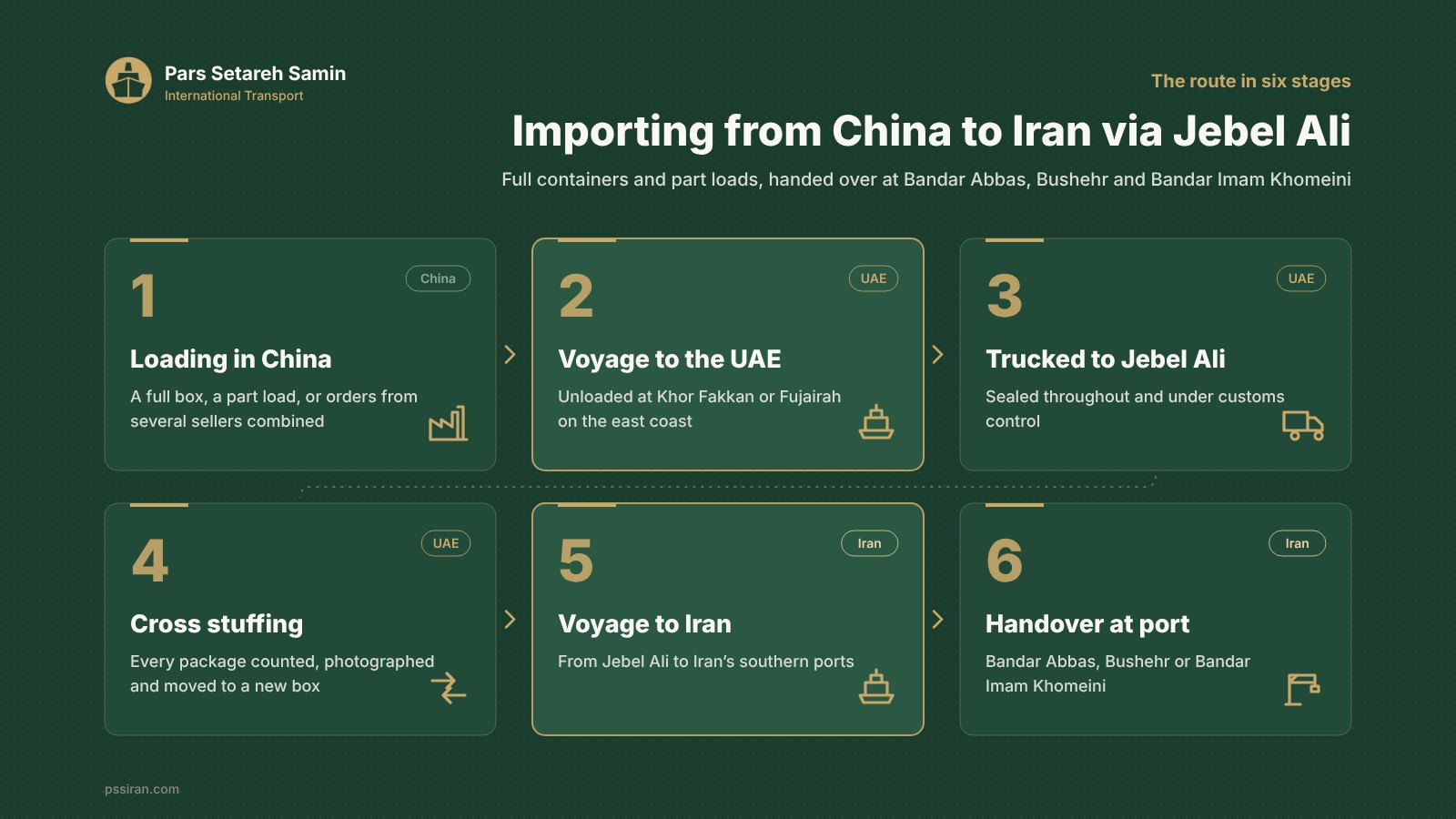
The box that carried your goods from China normally belongs to the shipping line on that leg and has to go back to it in the Emirates. So at Jebel Ali the cargo moves into another container, one that will take it all the way to the Iranian port. That transfer is called cross stuffing, and during it:
- every package is taken out, counted and photographed;
- anything damaged or missing is reported before the cargo leaves for Iran;
- goods are re-palletised, re-secured or re-labelled if they need it;
- one large consignment can be split between buyers, or between Iranian ports;
- goods from different sellers that reached Jebel Ali separately can be brought together in one container for one buyer.
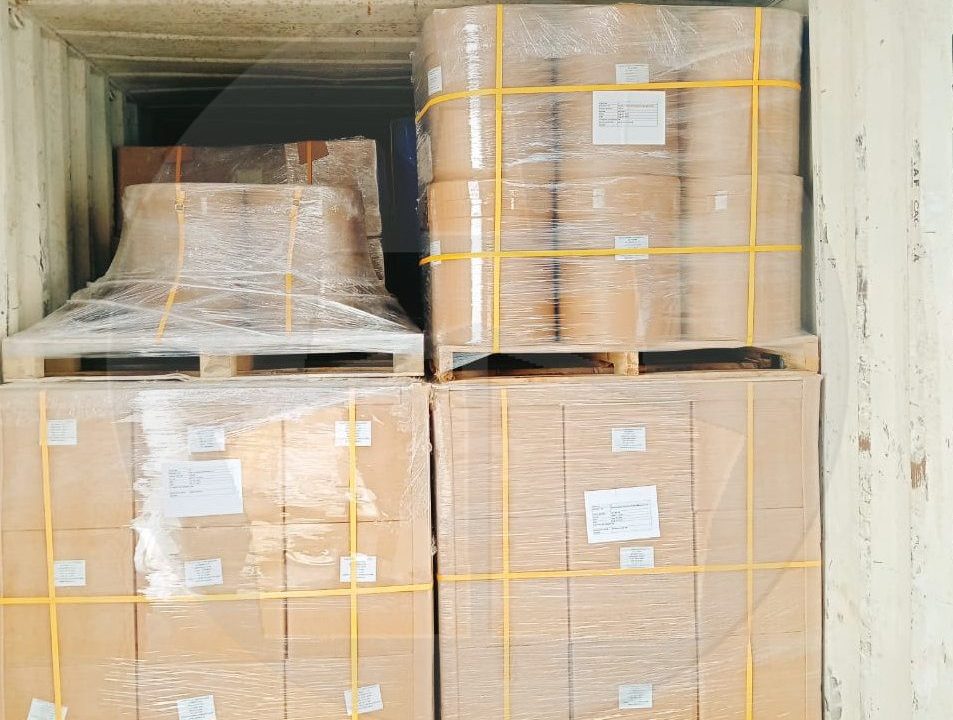
We look at when cross stuffing earns its keep, and when it doesn’t, in Cross stuffing in Jebel Ali: when it makes sense. To see what a container costs while it waits at Jebel Ali, try our Jebel Ali detention calculator and the Jebel Ali storage tariff.
Full container or part load?
We move both on this route. Here is how they compare:
| Point of comparison | Part load (LCL) | Full container (FCL) |
|---|---|---|
| Typical size | A few pallets, up to about 15 cubic metres | A 20ft, 40ft or 40ft high-cube box |
| How it is priced | On volume or weight, whichever comes out higher | A price per container |
| Handling | Grouped in China, then re-stowed at Jebel Ali | Opened only once, for cross stuffing |
| Suits | Samples, first orders, small repeat orders | Large orders, and heavy, costly or delicate goods |
A part load that grows to around half a 20ft container is the point where a full box starts to make sense, so at that size we price both options for you. Inside measurements and payloads for each container type are on our container dimensions page.
Before comparing container options, check how your cargo may fit in a container using the package dimensions, weights and stacking limits. A loading layout helps you discuss equipment needs; it does not determine the freight rate or replace the loading team's checks.
Combining orders from several Chinese sellers
Many Iranian importers buy from several factories in several Chinese cities. Ship each order separately as a part load and you end up with as many files, bills of lading and customs clearances in Iran as you have sellers. Instead, the orders can be combined. They are delivered to a single warehouse near the port, checked against your purchase orders and loaded together into one container.
- One container and one file, rather than a scatter of small shipments;
- packages counted and checked in China, before anything sets sail;
- heavy and light goods stowed side by side, so you pay for less empty space.
Iranian ports of discharge
From Jebel Ali we ship to Iran’s three main southern ports, and our job ends with handover at the port. Clearing the goods through Iranian customs is done by the consignee or their customs broker.
| Port | Serves best | Worth knowing |
|---|---|---|
| Bandar Abbas (Shahid Rajaee) | Most containerised cargo, and buyers in Tehran, central and eastern Iran | Iran’s biggest container port, with the most frequent links to Jebel Ali |
| Bushehr | Bushehr province, Fars and the south | The natural choice when the goods are going to Bushehr or Shiraz |
| Bandar Imam Khomeini | Khuzestan and the west and south-west | Suited to industrial cargo, metals and staples bound for Khuzestan and the west |
How long a container stays free at the destination, and what it costs after that, depends on the shipping line and the port. The Bandar Abbas detention calculator and the Shahid Rajaee storage tariff help you work these out. We also explain why containers so often end up waiting at Bandar Abbas.
Paperwork for importing from China to Iran
On this route, delays nearly always start with the documents rather than the ships. Before loading in China, check that each of these is complete and agrees with the others:
- Commercial invoice, describing the goods precisely, with HS code, value, currency and delivery terms that match your order registration.
- Packing list, showing package numbers and net and gross weights consistent with the invoice and the bill of lading.
- Order registration (sabt-e sefaresh) on Iran’s National Trade System, filed before shipment with the same particulars as the invoice.
- Bill of lading, naming the shipper, consignee and notify party correctly for a Jebel Ali routing.
- Certificate of origin, issued in China by CCPIT or by Chinese customs.
- Permits and certificates called for by the HS code, for example standards or health approvals.
Hazardous cargo, batteries and project shipments
Much of what Iran imports from China counts as hazardous cargo. That includes lithium batteries and power banks, electric bikes and scooters, energy-storage units, paints and chemicals. It travels under the IMDG Code, with a dangerous goods declaration, a safety data sheet (MSDS) and UN-approved packaging and labels. Each of these shipments is cleared with the shipping line individually before booking. Our dangerous goods page lists the classes. Heavy plant and oversized equipment are planned as project cargo.
China to Iran rates
We are building weekly rate pages for the main lanes from China to Iran. Until they are online, ask us for today’s rate for your particular cargo.
| Lane | Equipment | Weekly rate |
|---|---|---|
| Shanghai → Jebel Ali → Bandar Abbas | 20ft and 40ft containers | Coming soon |
| Ningbo → Jebel Ali → Bandar Abbas | 20ft and 40ft containers | Coming soon |
| Shenzhen → Jebel Ali → Bandar Abbas | 20ft and 40ft containers | Coming soon |
| Qingdao → Jebel Ali → Bandar Abbas | 20ft and 40ft containers | Coming soon |
| China → Jebel Ali → Bushehr | 20ft and 40ft containers | Coming soon |
| China → Jebel Ali → Bandar Imam Khomeini | 20ft and 40ft containers | Coming soon |
| China → Bandar Abbas | Part load, per cubic metre | Coming soon |
The price for any shipment depends on where the seller is in China, how much cargo there is or how many containers, what the goods are, whether grouping or cross stuffing is involved, which Iranian port you want and the delivery terms in your purchase contract.
Why Pars Setareh Samin?
- Over 30 years of experience among the group’s people in international freight to Iran.
- Our UAE operation handles the move from Khor Fakkan and Fujairah, the cross stuffing at Jebel Ali and the voyage to Iran as a single job.
- Licensed in Iran as an international freight forwarder.
- Full containers and part loads from every major Chinese port, plus combining of orders from different sellers.
- Every package counted and photographed at Jebel Ali before it sails for Iran.
- The same file manager from the seller’s warehouse to the Iranian port.
Asking us for a rate
The fuller the picture you give us, the sharper our answer. You can reach us through the rate request form, on WhatsApp or from the contact page. Please tell us:
- which city the seller or factory is in;
- what the goods are, and their HS code if you know it;
- the volume and weight, or how many containers and of what type;
- which Iranian port you need: Bandar Abbas, Bushehr or Bandar Imam Khomeini;
- your delivery terms (Incoterms) and when the goods will be ready;
- whether anything in the shipment is hazardous.
You will get back a suggested routing, a price and a checklist of the documents your shipment calls for.
Questions importers ask
Importing from China through Jebel Ali
Yes. Containers sail from China to Khor Fakkan or Fujairah, our UAE operation trucks them under customs control to Jebel Ali, and after cross stuffing the cargo continues by sea to Bandar Abbas, Bushehr or Bandar Imam Khomeini. Full containers and part loads both use this route.
Moving the cargo out of the container that came from China and into a new one that will carry it to Iran. Every package is counted and photographed along the way, and the first container goes back to the line that owns it.
Much of the container traffic from China to the Emirates now unloads at Khor Fakkan or Fujairah, on the Gulf of Oman. From there our UAE operation moves the container to Jebel Ali, sealed and under customs supervision.
Bandar Abbas (Shahid Rajaee), Bushehr and Bandar Imam Khomeini. Which one suits you depends on where the consignee is based and what the goods are.
No. Our service ends with handover at the Iranian port, and clearance is up to the consignee or their customs broker. We do make sure the documents are in shape for a smooth clearance.
Shanghai, Ningbo, Shenzhen and Qingdao, and also Tianjin, Xiamen and Guangzhou. Goods from sellers inland reach the port by train, river barge or truck.
Yes. Part loads are grouped in China, re-stowed at Jebel Ali and delivered to the Iranian port you choose. Once your cargo reaches roughly half a 20ft container, we also price a full container for comparison.
Yes. The orders go to one warehouse near the port, are checked against your purchase orders and loaded together. Goods from different sellers that arrive separately at Jebel Ali can also be joined in one container during cross stuffing.
A commercial invoice, packing list, order registration on Iran’s National Trade System, a bill of lading, a certificate of origin issued in China and whatever permits the HS code requires. They all need to agree with one another before loading.
Yes, as long as the shipping line accepts them, which we confirm for each shipment. They travel with a dangerous goods declaration, a safety data sheet and UN-approved packaging and labels.
Weekly rate pages for the main lanes are on the way. In the meantime, give us your cargo details through the rate request form or on WhatsApp and we will come back with today’s rate.
Related reading
Road freight from Europe to Iran: a complete guide to groupage (LTL) and full truck loads (FTL)
From anywhere in Europe to customs in Iran: which method suits your cargo, how the rate is calculated, which documents you need, and how far CMR insurance really goes.
View →Cross stuffing in Jebel Ali: when it makes sense and when it does not
Cross stuffing is a sound answer to a carrier restriction, but it does not suit every cargo. How to decide, and what documentation to insist on.
View →Five reasons your container is sitting at Bandar Abbas
Delay at Shahid Rajaee rarely has an exotic cause. It has five repeating ones, and most of them could have been settled before the vessel arrived.
View →Get your freight rate today
Send us the origin, destination, commodity and approximate weight. We reply within one working day.